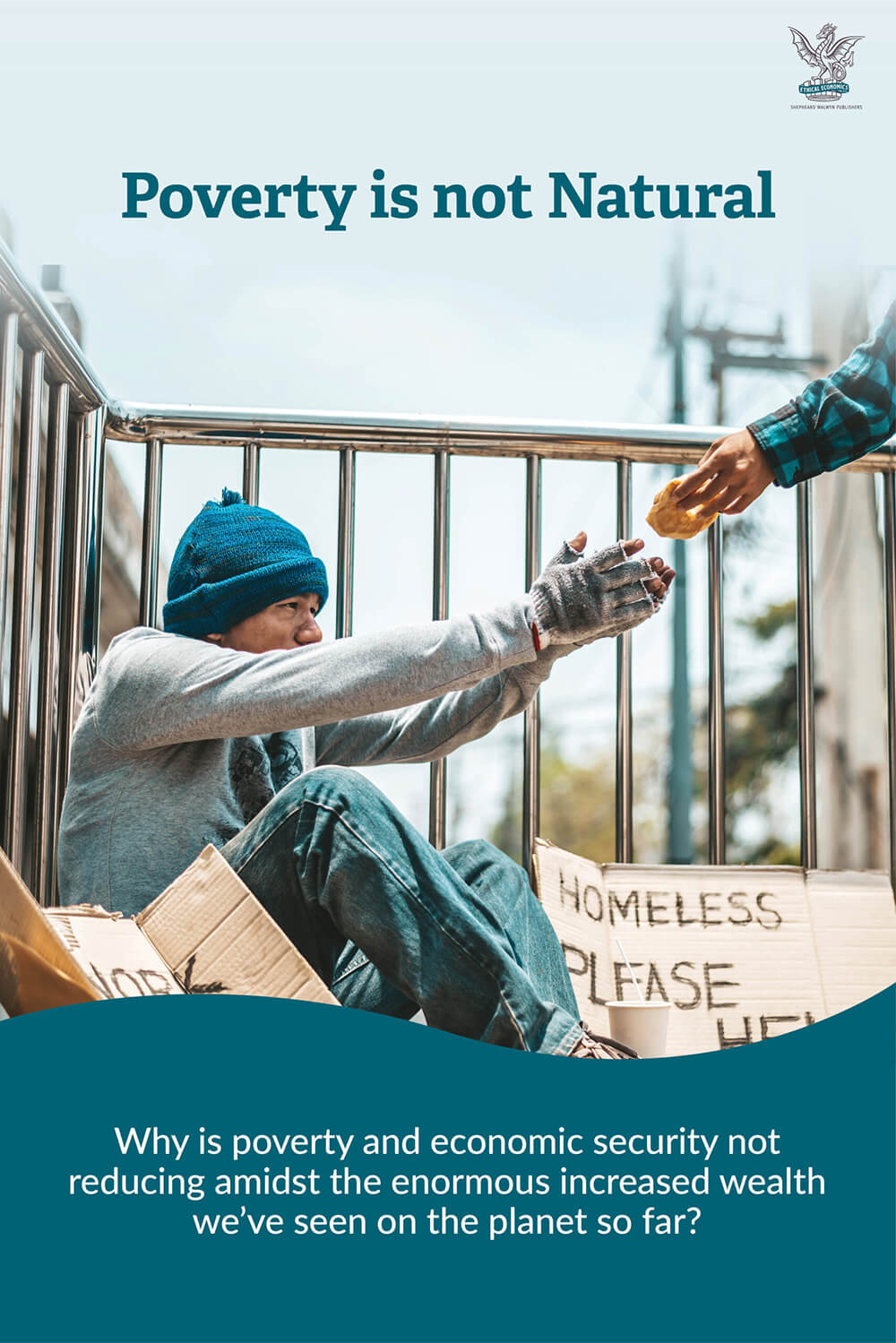


"Today we live in a world that is divided. A world in which we have made great progress and advances in science and technology. But it is also a world where millions of children die because they have no access to medicines… It is a world of great promise and hope. It is also a world of despair, disease and hunger"
Nelson Mandela
Governments still rely on economists steeped in orthodox thinking for advice. If things are to change, a clearer understanding of how the economy works is needed, not just by economists and policy-makers, but also by the wider general public – a voter who votes in ignorance forges the chains that bind him. Economists have erected round their subject an intimidating barrier of jargon and maths, but this site and the books in our catalogue are intended to give the layman, the voter, a grasp of the basic principles.
Anthony Werner, Publisher
Walter Rybeck shares with the reader his discovery that how property taxes are levied is crucial to this issue. He presents a strategy for gradually increasing beneficial taxes and reducing harmful ones.
ISBN 9780856832819 | Price: £18.95
Polly Higgins, the author of Eradicating Ecocide features in a new youtube video which has just been released.
From 21st Feb to 15th March, she will be visiting Canada and the United States for a book and lecture tour. We will be updating the dates and venues as they are confirmed:
Toronto – 18th Feb – 20th Feb
Vancouver – 20th Feb – 22nd Feb
Boulder, Colorado – 23rd Feb – 25th Feb
Comments (0) | Posted in Blog
Anthony Werner, the Managing Director of Shepheard-Walwyn was invited to attend the Dialogue of Civilizations at the World Public Forum held on the island of Rhodes last October. Here is an excerpt from his paper, which has now been published in the Journal of Globalisation for the Common Good:
‘Give us a guide,” cry men to the philosopher. “We would escape from these miseries in which we are entangled. A better state is ever present in our imaginations, and we yearn after it; but all our efforts to realize it are fruitless. We are weary of perpetual failures; tell us by what rule we may attain our desire.’
Witnessing the misery and poverty of mid 19th century Britain, Herbert Spencer, began his Social Statics with the above words. He had in mind, perhaps, Plato’s Republic on the role of the philosopher in educating a political elite – the guardians, as he called them. One of the best known passages from that work is that the human race ‘will never have rest from its evils until philosophers are kings, or kings have the spirit and power of philosophy, and political greatness and wisdom meet in one’.
In view of the present state of the world, I think we can agree that humanity has not yet found ‘rest from its evils’. In this paper we will explore whether there is any particular wisdom to be found in Political Economy that can guide a future political elite in lessening the evils currently suffered by humanity.
Political Economy, or Economics as it is now called, was not a distinct discipline at the time of Plato. It only became a special study in the second half of the 18th century, first in France under the Économistes, or Physiocrats as they are more commonly called, and then in Britain with Adam Smith, often referred to as the ‘father of modern economics’. Economics emerged as a distinct subject in circumstances similar to the ones we are now facing, a mal-functioning of the economic order, which led thinking men and women to ask whether there might be a better way. Likewise the Great Depression of the 1930s led to the emergence of Keynesian economics which has come back into fashion as a way of dealing with the present crisis, with many attributing the current turmoil to market failure, but, as will be argued in this paper, it is really a failure of governance. To find out what Anthony Werner means by this, please click here to view the whole paper.
Comments (0) | Posted in Uncategorized